
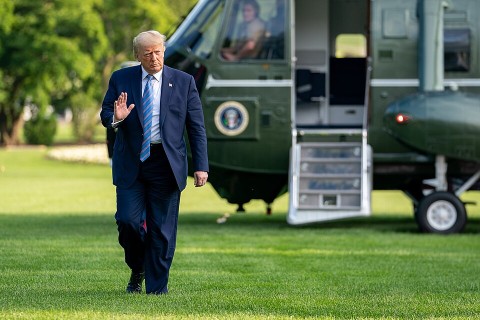
In a move signaling potential de-escalation, U.S. President Donald Trump announced a temporary halt to a planned military attack on Iran, originally set for Tuesday. This decision comes after discussions with key Gulf leaders, including Saudi Arabia’s Crown Prince Mohammed bin Salman, the Emir of Qatar Tamim bin Hamad Al Thani, and the UAE’s President Mohamed bin Zayed Al Nahyan, who assured Trump that earnest negotiations were underway and a satisfactory deal could soon be reached. Trump, in a post on Truth Social, emphasized that the proposed deal would ensure “no nuclear weapons for Iran,” a critical point of concern for the United States.
The U.S. President has instructed his defense team, led by Secretary Pete Hegseth and General Daniel Caine, to be in a state of readiness for a full-scale assault on Iran should the negotiations fail to produce an acceptable agreement. Trump underscored his respect for the Gulf leaders’ input, which influenced his decision to postpone the military action, but he also made it clear that the U.S. military remains on standby, prepared to act swiftly if necessary.
This development follows reports of Iran presenting a revised 14-point proposal to the U.S. through Pakistani intermediaries, aimed at resolving ongoing Middle Eastern tensions. However, according to a senior U.S. official, the adjustments in Tehran’s latest offer were perceived as insufficient and lacking substantial improvements, failing to address the core concerns of the U.S. regarding Iran’s nuclear ambitions.
The official further indicated that if Iran continues to maintain its current position on its nuclear program, the U.S. might have no choice but to resort to military measures, a prospect the official described as unfortunate. Although Iran’s recent proposal included minor changes, it seemingly reflects Tehran’s apprehension over potential U.S. military actions.